-
You have no items in your shopping cart.
- Register
- Log in
- Wishlist
- Shopping cart

48v Pure Sine Wave Inverter

48V 10000 Watt Pure Sine Wave Inverter
Inverter.com offers 48V pure sine wave inverters with power ratings ranging from 150W to 10000W, providing flexible options for different battery capacities and AC load requirements. Whether you are designing a solar battery storage system, upgrading an off-grid power installation, or building a reliable backup power solution, you can find a suitable 48V inverter for your project.
Why Choose a 48 Volt Pure Sine Wave Inverter for Your Power System?
① Lower DC Current for Higher-Power Applications. A 48V battery system can deliver the same power with lower DC current compared with 12V and 24V systems. This helps reduce current-related cable losses and makes 48V a practical choice for higher-power inverter installations, provided that the cables, connections, and protective devices are properly sized.
② Suitable for Solar Battery Storage Systems. 48 volt pure sine inverter can be integrated into compatible solar battery storage systems to convert stored DC energy into AC electricity. They provide a practical power conversion option for residential energy storage, off-grid installations, and backup power projects.
Important Factors When Installing a 48V Pure Sine Wave Inverter
- Verify Battery Bank Voltage and Configuration. A 48V inverter requires a compatible 48V battery bank. Unlike 12V or 24V systems, which typically use fewer batteries in series, a 48V system generally requires more battery units connected in series to achieve the required voltage. Ensuring the total battery voltage matches the inverter's DC input range.
- Pay Attention to DC Voltage Safety. A 48V battery system operates at a higher DC voltage than 12V and 24V systems. Although 48V is still considered low voltage in many electrical standards, its DC connections can deliver extremely high fault currents. Use properly rated DC circuit breakers, fuses, and disconnect switches. Always disconnect the battery before wiring or performing maintenance.
- Plan Grounding and System Protection. A 48V inverter may be integrated into a larger residential or commercial power system. Ensure the grounding arrangement, AC neutral-to-ground bonding, and DC negative grounding follow the inverter manufacturer's instructions and applicable local electrical codes. Do not assume that the grounding configuration is identical to a 12V or 24V installation.
Applications of 48 Volt Pure Sine Inverter
A 48V pure sine wave inverter is designed for high-power applications that require stable, efficient, and reliable AC power. Compared with 12V and 24V pure sine wave inverters, 48V models are better suited to larger power systems, long-term operation, and demanding electrical environments. They are widely used in commercial and industrial facilities, remote-area power supply projects, data center backup systems, and large-scale off-grid solar installations. By converting 48V DC power into clean AC electricity, they provide reliable power for sensitive electronic equipment, heavy-duty electrical loads, and critical infrastructure.
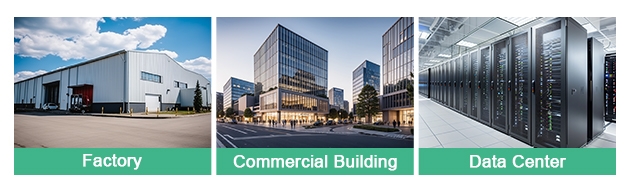
- Factory Equipment and Production Lines. In factories and manufacturing facilities, a 48V pure sine inverter can supply AC power to selected production equipment, control systems, monitoring devices, and auxiliary electrical loads. It is particularly useful in facilities that integrate battery storage or solar power systems to support essential operations during grid interruptions. For example, it can provide backup power for control panels, PLC systems, industrial computers, inspection instruments, and certain small production machines, helping maintain equipment operation and reduce unexpected production interruptions.
- Commercial Buildings and Office Facilities. Commercial buildings, offices, retail stores, and shopping facilities rely on electricity for lighting, communication, security, and daily operations. Typical applications include LED lighting, office equipment, network routers, security cameras, access control systems, and point-of-sale terminals. It helps businesses maintain basic operations during power outages and improves the flexibility of solar energy storage solutions.
- Network Equipment and Communication Systems. Network infrastructure is essential for maintaining data transmission and communication within data centers. Typical applications include network switches, routers, communication terminals, monitoring computers, and auxiliary networking devices. With a suitable battery bank, the inverter can help maintain the operation of selected communication equipment during short-term power interruptions.
