
In today's world, inverters have become an essential part of our daily lives. From providing emergency power during blackouts to running off-grid solar systems, inverters allow us to convert DC (direct current) electricity, commonly from batteries or solar panels, into AC (alternating current) electricity suitable for household appliances. Among the different types of inverters, modified sine wave inverters are popular due to their affordability and availability. However, a common question arises: Can a modified sine wave inverter power sensitive electronics safely? This article explores this question in detail.

What is a Modified Sine Wave Inverter?
A modified sine wave inverter converts DC power into AC power in a waveform that is a rough approximation of a pure sine wave. Unlike a pure sine wave inverter, which produces a smooth and continuous AC waveform similar to utility power, a modified sine wave inverter generates a stepped, square-like waveform. Essentially, it produces a square-shaped AC output with flat segments, causing a waveform that rapidly jumps between voltage levels rather than smoothly oscillating.
The advantages of modified sine wave inverters are significant: they are less expensive, simpler in design, and sufficient for powering many household appliances such as lights, fans, and heating devices. Additionally, they are lightweight and easy to maintain, making them a popular choice for budget-conscious consumers or for use in vehicles, boats, and small off-grid solar systems.
While they are not ideal for all applications, modified sine wave inverters offer a practical balance between cost and performance, making them suitable for users who need reliable AC power for everyday devices without the higher expense of a pure sine wave inverter.
How Does a Modified Sine Wave Inverter Affect Sensitive Electronics?
Sensitive electronics are devices or components that can be easily affected or damaged by fluctuations in electrical power, electromagnetic interference, static electricity, heat, or improper operating conditions. These electronics are designed to work within very specific voltage, current, and frequency ranges, and even small deviations can lead to malfunction, reduced accuracy, data loss, or permanent damage. Common examples of sensitive electronics include computers, laptops, smartphones, tablets, medical equipment, laboratory instruments, communication devices, audio-visual equipment, and precision industrial controllers.
Modified sine wave inverters convert DC power into an AC output that approximates a sine wave using stepped or square-like voltage levels rather than a smooth curve. While this design is cost-effective and works well for many basic appliances, sine wave modification can significantly affect sensitive electronic devices.
One major issue is electrical noise and harmonics. Sensitive electronics, such as medical equipment, audio devices, laboratory instruments, and some communication systems, are designed to operate on clean, stable power. The sharp transitions in a modified sine wave generate high-frequency harmonics that can interfere with internal circuits. This interference may cause audible buzzing in speakers, distorted signals, data errors, or unstable operation.
Another effect is increased heat generation. Many sensitive devices use transformers, capacitors, or induction components that are optimized for a pure sine wave. When powered by a modified sine wave, these components may operate inefficiently, drawing extra current and producing excess heat. Over time, this additional thermal stress can shorten component lifespan and increase the risk of premature failure.
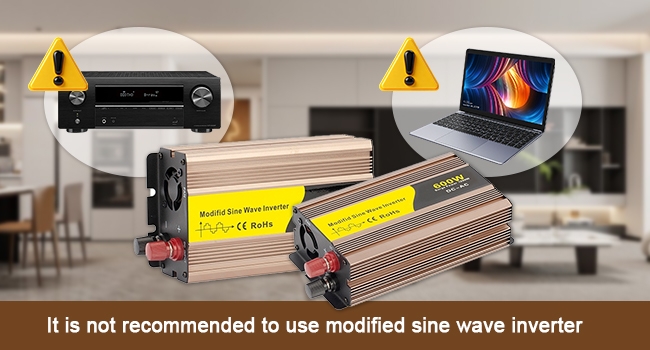
For Sensitive Electronic
- Example 1: Laptop Charging. Many laptop chargers with switch-mode power supplies can tolerate modified sine wave input. However, some high-end laptops may charge more slowly, and the charger may become warm to the touch. Short-term use is usually safe, but frequent long-term use can stress the charger.
- Example 2: CPAP Machine. CPAP machines, which are critical for individuals with sleep apnea, often rely on precise electronics. Using a modified sine wave inverter can cause unusual noise, inaccurate airflow settings, or even failure. A pure sine wave inverter is strongly recommended.
- Example 3: Audio Amplifier. An audio amplifier powered by a modified sine wave inverter may emit a constant hum, distort audio signals, and produce excessive heat in its transformer. Audiophiles usually prefer pure sine wave inverters to maintain sound quality and protect equipment.
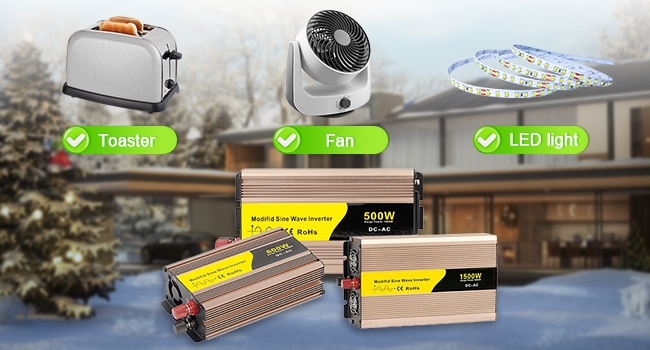
What Appliances are Compatible with Modified Sine Wave Inverter?
Modified sine wave inverters are versatile and can power a range of household and recreational devices. They are generally suitable for appliances that do not have sensitive electronics or precise timing requirements. Some common examples include:
- Lighting: Incandescent bulbs, halogen lamps, and some LED lights. 300W modified sine wave inverter is suitable for these devices.
- Heating devices: Electric heaters, toasters, and coffee makers, which rely on resistive heating elements.
- Simple motors: Fans, hair dryers, and some power tools that do not require smooth or continuous waveforms.
These inverters are also widely used in recreational settings, such as camping or RV travel, where powering basic appliances is needed. Examples include:
- Small kitchen appliances: Microwaves, blenders, and slow cookers (though performance may be slightly less efficient).
- Entertainment devices: Older televisions, DVD players, and radios that are less sensitive to waveform distortion.
Conclusion
So, can a modified sine wave inverter power sensitive electronics? The short answer is: sometimes, but with caution. Modified sine wave inverters are suitable for simple devices like lights, heaters, and some chargers, but sensitive electronics, especially those with microprocessors, or audio circuits—may experience noise, overheating, inefficiency, or permanent damage.
For users intending to power computers, medical devices, high-fidelity audio equipment, or other sensitive electronics, investing in a pure sine wave inverter is the safest option. While modified sine wave inverters remain cost-effective and reliable for many everyday appliances, understanding their limitations and testing device compatibility is crucial for protecting valuable electronics.
In the end, the decision depends on balancing cost, convenience, and the importance of device safety. For critical or expensive electronics, choosing quality pure sine wave power is an investment in reliability and peace of mind. Anyway, both modified sine wave inverters and pure sine wave inverters are available for purchase on Inverter.com.
