
A frequency inverter — also called a variable frequency drive (VFD), AC drive, or inverter drive — is a power control device that adjusts the frequency and voltage supplied to an AC motor, enabling precise speed control and reducing energy consumption by up to 50% compared to direct-on-line starting. As industrial automation continues to advance, frequency inverters have become one of the most widely adopted motor control solutions across manufacturing, HVAC, water treatment, and more.
This guide published by inverter.com covers everything you need to know about frequency inverter basics: what it is, how it works internally, how it's classified, what functions it provides, and why it saves energy.
Table of Contents
- What Is a Frequency Inverter?
- Internal Structure of a Frequency Inverter
- How a Frequency Inverter Works: AC–DC–AC Process
- Classification of Frequency Inverters
- Key Functions of a Frequency Inverter
- Frequency Inverters and Energy Saving
- Advantages of a Frequency Inverter at a Glance
- Frequently Asked Questions
- Ready to Shop?
What Is a Frequency Inverter?
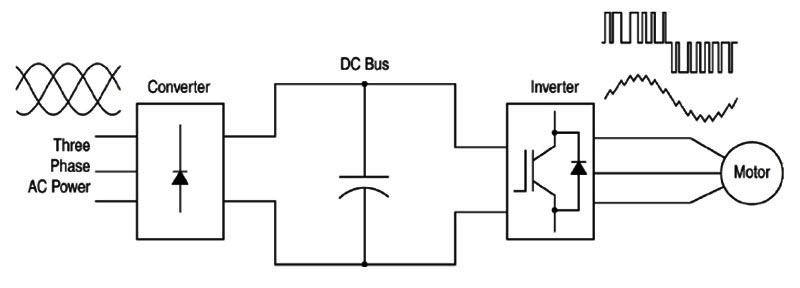
A frequency inverter converts a fixed-frequency AC power supply (50 Hz or 60 Hz) into an AC output with adjustable frequency and voltage, allowing variable-speed operation of AC motors. Inside the device, the control circuit manages the main circuit; the rectifier stage converts incoming AC to DC; the DC intermediate bus filters and smooths that DC; and the inverter stage converts it back to AC at the target frequency.
For vector control inverters — which require torque calculations — a dedicated CPU handles the math alongside the power conversion circuitry. Speed regulation is achieved by changing the frequency of the power delivered to the motor's stator winding.
Internal Structure of a Frequency Inverter
A frequency inverter is built around four functional stages:
- Rectifier: Converts the incoming AC supply to DC voltage using a rectifier bridge. This provides a stable DC source for the stages that follow.
- DC Bus Filter: Smooths the rectified DC using inductors and capacitors, reducing voltage ripple and harmonics to ensure stable system operation.
- Inverter (Power Stage): The core of the device. Using modern power semiconductors — typically IGBTs (Insulated Gate Bipolar Transistors) or MOSFETs — this stage converts the filtered DC back into AC at a controlled, variable frequency and amplitude to drive the motor.
- Control Circuit: The intelligent layer. It monitors motor operating status, receives external input signals (analog, digital, or serial), and regulates motor speed and torque via algorithms such as PID (Proportional-Integral-Derivative) control or field-oriented vector control.
How a Frequency Inverter Works: AC–DC–AC Process
The AC–DC–AC conversion process is what distinguishes a frequency inverter from a simple transformer or relay:
- AC → DC (Rectification): The rectifier bridge converts grid AC to raw DC.
- DC filtering: Capacitors and inductors smooth the DC bus voltage.
- DC → Variable-frequency AC (Inversion): IGBTs switch at high frequency using PWM (Pulse Width Modulation) to synthesize an AC waveform at any target frequency from 0 Hz to 400 Hz or higher.
This three-stage process gives the drive complete, independent control over both output frequency (speed) and output voltage (torque), which is the foundation of all VFD energy-saving and motor-protection capabilities.
Classification of Frequency Inverters
Frequency inverters are classified along several dimensions:
| Classification Basis | Types |
| Main Circuit Working Mode | Voltage-type (VSI) · Current-type (CSI) |
| Switching / Modulation Method | PAM control · PWM control · High-carrier-frequency PWM |
| Control Algorithm | V/f (Volts-per-Hertz) · Sensorless vector · Closed-loop vector (FOC) |
| Application / Phase Configuration | General-purpose · High-performance dedicated · Single-phase · Three-phase · High-frequency |
Voltage-type (VSI): Uses a large DC bus capacitor as the energy storage element. DC voltage is smooth, and the drive behaves as a voltage source — the most common type for general industrial use.
Current-type (CSI): Uses a large DC bus inductor. The drive behaves as a current source and can handle rapid, large load-current swings — preferred for heavy-duty applications with highly variable loads.
V/f control: Maintains a fixed voltage-to-frequency ratio. Simple, robust, and sufficient for fans, pumps, and most constant-torque loads.
Vector control (FOC): Independently regulates motor flux and torque-producing current for high-performance applications — machine tools, hoists, conveyors — where rapid acceleration and precise speed hold are required.
Key Functions of a Frequency Inverter
- Speed Regulation: A VFD adjusts motor speed continuously across a wide range by changing output frequency. This is essential wherever different process steps require different speeds — conveyor lines, mixing systems, CNC spindles, and more.
- Energy Saving: For fan and pump loads, power consumption follows the Affinity Laws: reducing motor speed by 20% cuts power by nearly 50%. A VFD eliminates the wasted energy of throttling valves and mechanical dampers by matching motor output to actual load demand.
- Smooth Soft Starting: Direct-on-line (DOL) starting draws 5–8× the motor's rated current in an instant, creating mechanical shock and thermal stress. A frequency inverter ramps voltage and frequency up gradually, keeping starting current below rated levels and dramatically reducing wear on motors, couplings, and driven equipment.
- Precise Motor Control: VFDs support constant-speed, timed, and positioning control modes. Built-in PID control can close the loop directly with a pressure, flow, or temperature sensor — eliminating a separate controller and simplifying wiring.
- Reduced Mechanical Wear: By eliminating the jerk of direct starting and allowing controlled deceleration profiles (ramp-to-stop, free-coast, DC braking), a frequency inverter reduces mechanical stress across the entire drivetrain, extending equipment service life.
- Power Grid Quality Improvement: A well-designed VFD reduces harmonic injection into the supply network and limits inrush current peaks, improving power quality for other equipment on the same circuit.
Frequency Inverter and Energy Saving
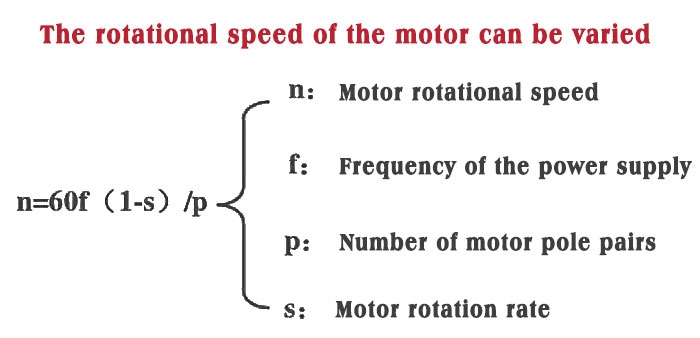
The energy-saving potential of VFDs is greatest on variable-torque loads (fans, pumps, compressors). According to the fluid mechanics Affinity Laws:
- Shaft power is proportional to the cube of rotational speed
- Reducing speed by 20% → power drops by ~49%
- Reducing speed by 30% → power drops by ~66%
Most fan and pump motors are sized for peak demand but spend the majority of their operating hours at partial load. Running them at full speed and throttling output with valves or dampers wastes all that excess energy. A VFD eliminates the throttle and runs the motor at the speed the process actually needs.
For direct-on-line starting, the motor draws 5–8× rated current momentarily. A frequency inverter limits starting current to below rated levels, reducing electrical infrastructure stress and peak-demand charges.
Advantages of a Frequency Inverter at a Glance
| Advantage | Detail |
| Energy savings up to 50% | Fan/pump loads following Affinity Laws; eliminates throttling losses |
| Precise speed control | Continuously variable from near-zero to above base speed |
| Soft starting | Limits inrush current to rated levels; eliminates mechanical shock |
| Extended motor life | Reduces thermal and mechanical stress on every start/stop cycle |
| Reduced equipment wear | Lower mechanical shock on couplings, gearboxes, and driven machinery |
| Built-in motor protection | Over-current, over-voltage, overload, and phase-loss protection |
| Reversible operation | Direction reversal via software — no additional contactors required |
| Wide application range | Pumps, fans, compressors, conveyors, CNC, HVAC, and more |
| Grid-friendly operation | Reduces inrush peaks and harmonic injection vs. DOL starting |
Frequently Asked Questions
Q1: What is the difference between a frequency inverter and a VFD?
They are the same device. "Frequency inverter," "variable frequency drive (VFD)," "AC drive," and "inverter drive" are all terms for the same motor controller. "VFD" is more common in North America; "frequency inverter" is the preferred term internationally.
Q2: What is the difference between a frequency inverter and a power inverter?
A power inverter converts DC (from a battery or solar panel) to fixed-frequency AC, so you can run household appliances off a DC source. A frequency inverter takes AC input and outputs AC at a variable frequency to control motor speed — it does not change DC to AC.
Q3: How much energy can a frequency inverter save?
On fan and pump applications, a VFD typically cuts energy consumption by 30–50% compared to running at fixed speed with a throttle valve or damper. The exact saving depends on load profile, but the Affinity Laws guarantee that even a modest speed reduction produces a large power reduction.
Q4: Can a frequency inverter run a single-phase motor from a three-phase supply, or vice versa?
Yes. Single-phase-to-three-phase VFDs accept 220V single-phase input and produce three-phase output, letting you run three-phase motors without upgrading your utility service. Single-phase output VFDs are also available for single-phase motor applications.
Q5: What protection functions does a frequency inverter provide?
Standard protections include: over-current, over-voltage, under-voltage, overload (electronic thermal), phase loss, short-circuit, over-temperature, and stall prevention. These protect both the drive and the connected motor.
Q6: When should I choose vector control over V/f control?
Use V/f control for simple fan/pump/conveyor applications where speed accuracy of ±2–3% is acceptable. Choose sensorless or closed-loop vector control when you need high starting torque at low speed, tighter speed regulation (±0.5% or better), or dynamic torque response — hoists, machine tools, extruders.
Ready to Shop?
Inverter.com stocks frequency inverters from 0.4 kW to 220 kW across four configurations — single-phase in/out, single-to-three-phase, three-phase, and 120V input models for the North American market. All in-stock units ship from our Los Angeles, CA warehouse.
