
If you're looking for a drive to run a water pump off solar panels, you've likely come across two options: a solar pump inverter and a regular VFD (variable frequency drive). They look similar, both control motor speed, and their spec sheets often overlap — so which one do you actually need?
The short answer: they solve different problems. This guide breaks down exactly how they differ, where each one excels, and how to choose the right device for your application.
Table of Contents
- What Is a Regular VFD (Frequency Inverter)?
- What Is a Solar Pump Inverter?
- The Core Difference: Power Source and Control Logic
- Feature Comparison: 5 Key Dimensions
- Side-by-Side Spec Comparison
- Can You Use a Regular VFD Instead of a Solar Pump Inverter?
- Which One Is Right for Your Application?
- Buying Guide: What to Look For?
- Summary
What Is a Regular VFD (Frequency Inverter)?
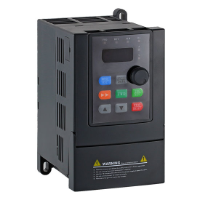
A variable frequency drive (VFD) — also called a frequency inverter or AC drive — is an industrial device that controls the speed of an AC motor by adjusting the frequency and voltage of its power supply. Instead of running a motor at a fixed speed, a VFD lets you dial in precisely the RPM your application requires. Internally, a VFD works in three stages:
- Rectifier — converts incoming AC power to DC
- DC bus — filters and stores the DC energy
- Inverter stage — converts DC back to AC at the target frequency
This AC → DC → AC process enables smooth, stepless speed control without any mechanical components. A critical design assumption of every standard VFD: the input power is stable grid AC at a fixed voltage and frequency (220 V / 380 V / 480 V, 50 or 60 Hz). The control logic is built entirely around that premise.
Inverter.com carries frequency inverters from 0.4 kW to 220 kW across four input/output configurations: single-phase output inverters, single-phase to three-phase inverters, three-phase inverters, and 120 V input inverters (for the North American market).
What Is a Solar Pump Inverter?
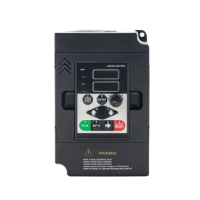
A solar pump inverter is a purpose-built drive for photovoltaic (PV) water pumping systems. Its primary job is to convert the DC output of solar panels into AC power to run a water pump motor.
What separates it from a standard VFD is the built-in MPPT (Maximum Power Point Tracking) controller. Because solar panel output fluctuates constantly with cloud cover, temperature, and sun angle, the MPPT module continuously scans the panel's voltage–current curve and locks the operating point onto the peak power output at any given moment. The inverter then adjusts its output frequency accordingly — running the pump faster when more solar power is available, and slower when it isn't. Solar pump inverters also include pump-specific protection features—dry-run protection, auto sleep/wake, and water level sensor inputs—that are absent from standard VFDs.
Inverter.com offers solar pump inverters from 0.75 kW to 45 kW, with single-phase, single-to-three-phase, and three-phase 380V output options. The DC input range is 120V to 750V to match a wide range of PV array configurations.
The Core Difference: Power Source and Control Logic
The most fundamental difference between these two devices is the nature of the input power.
A regular VFD is connected to the grid. Voltage and frequency are stable and predictable. The VFD simply adjusts its output to match whatever speed setpoint the operator or control system requests.
A solar pump inverter faces an entirely different input environment. A PV array's DC output fluctuates continuously throughout the day — low at sunrise and sunset, peaking around noon, and dropping suddenly whenever clouds pass. Running a pump at a fixed frequency under these conditions would either stall the motor (too little power) or waste available energy (fixed low speed on a bright afternoon).
This is why the solar pump inverter's control logic is fundamentally different: it first determines the maximum power available from the panels, then sets the pump speed to match that power. The pump runs as fast as the sun allows — no more, no less. That single design difference drives nearly every other distinction between the two devices.
Feature Comparison: 5 Key Dimensions
🔴Input Power Type
- Regular VFD: AC-only input — single-phase 220V or three-phase 380V / 480V. Requires a stable grid connection. Cannot accept DC from solar panels directly.
- Solar Pump Inverter: Accepts both DC (solar) and AC (grid or generator) inputs. During daylight hours, it draws from the PV array. On overcast days or at night, it can automatically switch to an AC backup source to keep the pump running.
🔴MPPT — Maximum Power Point Tracking
- Regular VFD: No MPPT. The control logic assumes a stable input and has no mechanism to hunt for a changing power maximum.
- Solar Pump Inverter: Built-in MPPT controller. On inverter.com's three-phase 380V models, the recommended MPPT operating range is 350V~750V DC; single-phase models target 250V~400V DC. The MPPT algorithm continuously sweeps the panel's operating curve and locks onto the peak power point.
In practice, MPPT can increase solar energy utilization by 20~30% compared to running at a fixed voltage — a meaningful gain over the lifetime of the system.
🔴Pump-Specific Protection Features
- Regular VFD: Provides standard motor protections — overvoltage, undervoltage, overcurrent, and thermal overload. No pump-specific logic is built in.
- Solar Pump Inverter: Adds a full suite of pump-focused protections on top of the standard set:
| Protection | What It Does |
| Dry-run protection | Detects when the well or tank runs dry and shuts down to prevent motor burnout |
| Auto sleep / wake | Enters sleep mode when solar power drops below the start threshold; automatically restarts at sunrise |
| High water level stop | Integrates with a level sensor to shut off the pump when the tank is full |
| Low-frequency protection | Stops the pump if output frequency drops too low for the pump to operate safely |
For unattended rural or agricultural installations, these protections are not optional extras — they're the reason the system can run without an operator on site.
🔴Speed Control Logic
- Regular VFD: The operator or a PLC sends a target frequency setpoint. The drive matches that setpoint precisely. Speed regulation accuracy typically reaches 1:100, making standard VFDs the right tool for processes that require tight speed control.
- Solar Pump Inverter: The drive continuously calculates the maximum usable power from the PV array and sets the output frequency to consume exactly that power. The user configures upper limits and protection thresholds; day-to-day speed management is fully automatic.
🔴Installation Environment
- Regular VFD: Designed for installations with reliable grid power — factories, municipal water systems, commercial buildings. Typically mounted in a panel enclosure. Requires a trained technician for commissioning.
- Solar Pump Inverter: Designed for off-grid or weak-grid locations — remote farmland, desert reclamation sites, island communities. IP20-rated for indoor mounting, RS485 communication for remote monitoring, and simple enough to commission without specialist tools. The system runs autonomously after initial setup.
Side-by-Side Spec Comparison
| Feature | Regular VFD (Frequency Inverter) | Solar Pump Inverter |
| Input power | AC grid (single- or three-phase) | DC (solar) + AC (backup) |
| MPPT | ❌ Not included | ✅ Built-in |
| Output frequency range | 0–1000 Hz (adjustable) | 0–50/60 Hz (auto-matched to solar power) |
| Speed control logic | Follows operator setpoint | Auto-matches available PV power |
| Dry-run protection | ❌ Requires external module | ✅ Built-in |
| Auto sleep / wake | ❌ Not available | ✅ Built-in |
| Water level sensor input | ❌ Requires external PLC | ✅ Supported |
| DC/AC dual input | ❌ Not available | ✅ Built-in |
| Typical power range | 0.4 kW–220 kW | 0.75 kW–45 kW |
| Grid dependency | Required | Optional (AC backup only) |
| Primary application | Industrial motor speed control | Solar-powered water pumping |
| Communication | RS485 / Modbus | RS485 / Modbus |
Can You Use a Regular VFD Instead of a Solar Pump Inverter?
This is one of the most common questions buyers ask when comparing the two devices. The technical answer: it's possible in very limited configurations, but in practice it means poor performance, higher risk, and no manufacturer support. Here's why:
- No power point tracking: A standard VFD runs at a fixed frequency. When solar irradiance drops, the panel voltage falls outside the VFD's expected input range, triggering undervoltage faults or causing repeated nuisance trips. The system cannot gracefully adapt to changing solar conditions.
- DC input incompatibility: Most standard VFDs are designed for AC rectification at their input terminals. Some models do allow direct DC injection at the bus, but the voltage range, ripple tolerance, and input characteristics rarely align with a PV array's output profile. Using a VFD this way voids the warranty and risks equipment damage.
- No dry-run protection: If the well runs dry and no external protection module is wired in, the pump will run unloaded until the motor overheats and burns out. In unmanned agricultural settings, this is a real and costly failure mode.
- No automatic operation: Without auto sleep/wake, someone must manually start the system at sunrise and stop it at sunset — or add external timers and relays, increasing system complexity and cost.
Bottom line: If your application involves solar power and a water pump, use a purpose-built solar pump inverter. If you have a stable grid connection and need motor speed control, a frequency inverter is the right tool. Using one in place of the other creates avoidable problems.
Which One Is Right for Your Application?
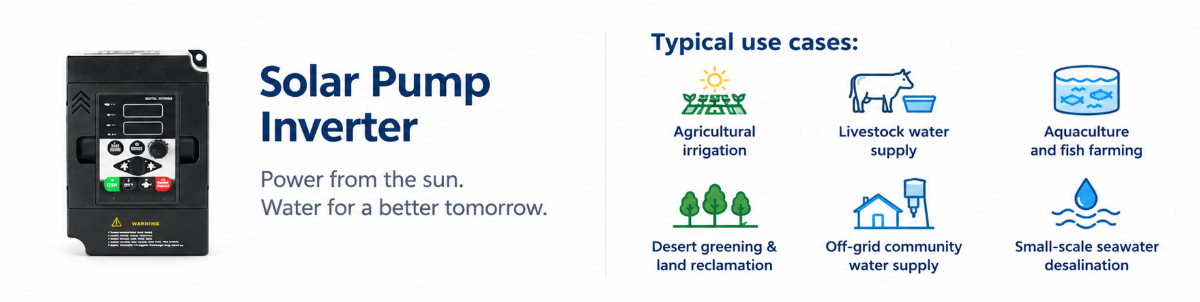
Choose a Solar Pump Inverter when:
Your power source is a PV array, with no reliable grid connection
The installation site is remote, unmanned, or off-grid
You need the system to start and stop automatically with daylight
The load is a water pump for irrigation, livestock watering, aquaculture, or domestic supply
Dry-run protection and water level control are required
Typical use cases:
Agricultural irrigation (farmland, greenhouses, orchards)
Livestock and ranch water supply
Aquaculture and fish farming
Desert greening and land reclamation
Off-grid community water supply
Small-scale seawater desalination
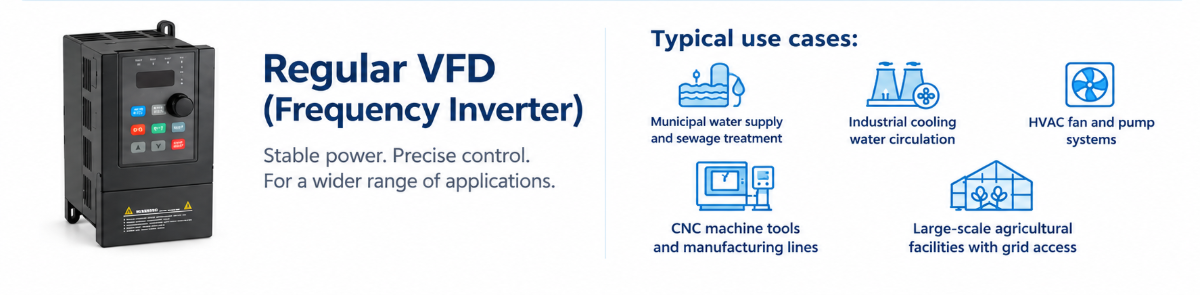
Choose a Regular VFD (Frequency Inverter) when:
You have a stable grid power supply
You need precise, programmatic speed control
The application requires wide power coverage (above 30 kW)
The load is a fan, compressor, conveyor, or other industrial equipment
Integration with a PLC or SCADA system is required
Typical use cases:
Municipal water supply and sewage treatment
Industrial cooling water circulation
HVAC fan and pump systems
CNC machine tools and manufacturing lines
Large-scale agricultural facilities with grid access
Buying Guide: What to Look For?
| Selecting a Solar Pump Inverter | |
| Parameter | What to Check |
| Power rating | Match or exceed your pump motor's nameplate kW |
| Output phase | Single-phase pump → single-phase output; three-phase pump → three-phase output |
| MPPT voltage range | Design your PV string voltage to fall within the inverter's recommended MPPT range (e.g., 250~400V or 350~750V DC) |
| Dual input (DC + AC) | Required if you need grid/generator backup on cloudy days or at night (SP1S series) |
| Communication | RS485 / Modbus for remote monitoring |
| Protection features | Confirm dry-run protection, auto sleep, and high-water-level stop are included |
| Selecting a Regular VFD | |
| Parameter | What to Check |
| Rated current | VFD rated current should be at least 10% above the motor's nameplate current |
| Input/output phase | Match to your site's power supply and motor configuration |
| Load type | Standard duty for fans and pumps; heavy duty (150% overload / 60 s) for compressors and conveyors |
| Control mode | V/F for simple applications; sensorless vector for better torque at low speed |
| Communication protocol | RS485 Modbus is standard; verify if CANopen or Profibus is needed |
| IP rating | IP20 for clean indoor panels; IP54 or higher for washdown or outdoor installations |
Summary
Solar pump inverters and regular VFDs share a common foundation — both convert electrical power to drive an AC motor at variable speed — but they are engineered for fundamentally different environments.
A regular VFD delivers precise, programmable speed control for grid-powered industrial and commercial applications, with a power range extending to 220 kW and tight integration into automation systems.
A solar pump inverter is purpose-built for photovoltaic water pumping: it tracks the PV array's maximum available power in real time, adapts pump speed automatically, and protects the pump and system without any operator involvement.
The two products are complementary, not competitive. The right choice depends on one question: where is your power coming from?
Stable grid power + motor speed control → Frequency Inverter (VFD)
Solar panels + water pump → Solar Pump Inverter
| |
|
| Solar Pump Inverter | Frequency Inverter (VFD) |
Browse the full product range at inverter.com, or contact our technical team for sizing support.
