
Against the backdrop of global energy transition and sustainable development, solar photovoltaic (PV) power generation—as a key form of green energy—has attracted increasing attention and adoption worldwide. In a solar PV system, photovoltaic panels and solar inverters are two core components. Their performance and degree of matching directly determine the overall power generation efficiency, system stability, and economic performance. A thorough understanding of the relationship between solar panel efficiency and inverter selection is therefore of vital importance for achieving optimal power generation results.
Photovoltaic Panel Efficiency
First of all, Inverter Online Store would like to talk about the PV panels. Photovoltaic panel efficiency is a key indicator used to measure a panel’s ability to convert solar energy into electrical energy. It directly determines how much electricity a solar panel can generate under the same sunlight conditions. At present, the mainstream photovoltaic panel technologies on the market mainly include monocrystalline silicon, polycrystalline silicon, and thin-film solar panels. Among them, monocrystalline photovoltaic panels stand out in terms of power generation efficiency, typically reaching around 20%. The high efficiency of monocrystalline solar panels is mainly attributed to their unique crystal structure. Although the manufacturing process is relatively complex, it results in high photoelectric conversion efficiency, good stability, and a long service life. These advantages have enabled monocrystalline PV panels to maintain a dominant position in the solar power generation industry and to be widely used in various photovoltaic power projects.
The power generation efficiency of monocrystalline photovoltaic panels is not determined solely by the material itself; it is also affected by factors such as solar irradiance, sun angle, and ambient temperature. For example, under low-light conditions or in high-temperature environments, solar panel efficiency often decreases. Reduced light intensity leads to fewer photons, which in turn limits electricity generation. Similarly, high temperatures increase carrier recombination rates in semiconductor materials, thereby reducing photovoltaic efficiency. Therefore, in practical applications, these influencing factors must be considered comprehensively to ensure that solar panels operate under optimal conditions and achieve maximum energy output.
Solar Inverter Selection
As a core device in a solar photovoltaic power generation system, the inverter converts the DC power generated by photovoltaic panels into AC power for use by households, businesses, and other electrical loads. The performance of a solar inverter directly affects the efficiency, stability, and reliability of the entire PV system. When selecting an inverter, multiple factors must be taken into account.
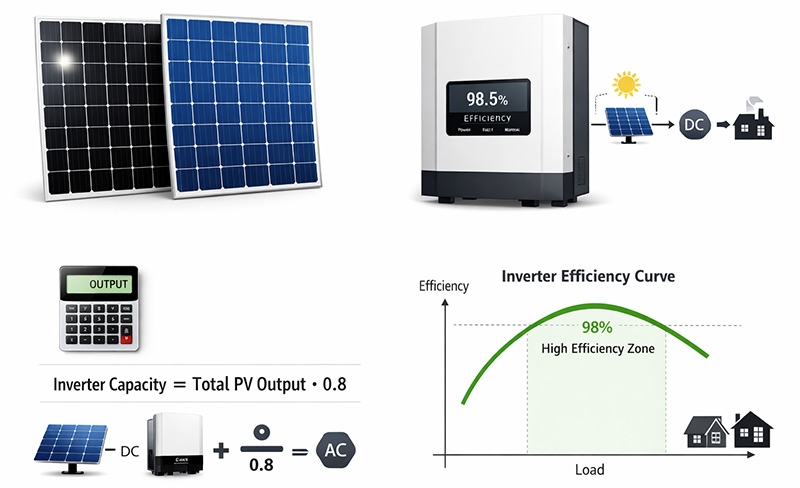
- Power Rating Matching: The rated power of the inverter should match the total rated output power of the solar panels. In practice, the inverter’s rated capacity is often designed to be slightly higher than the total panel capacity to ensure efficient energy utilization. Solar panel output fluctuates due to variations in sunlight and temperature. If the inverter capacity is too small, it may limit output during peak generation periods, reducing overall system efficiency. Conversely, an oversized inverter may introduce unnecessary conversion losses, leakage current, and increased system cost, negatively impacting efficiency and lifespan. A commonly used calculation formula is: Inverter Capacity = Total PV Output Power ÷ 0.8. Here, 0.8 represents the theoretical maximum conversion efficiency of a photovoltaic system.
- Conversion Efficiency: Inverter conversion efficiency is a critical performance indicator. The higher the efficiency, the less energy is lost during DC-to-AC conversion, resulting in higher overall power generation and improved economic returns. Today, many advanced solar inverters achieve conversion efficiencies of over 98% ( for example, the phase-split off-grid inverters available on our website achieve an efficiency of up to 99%), significantly enhancing the total efficiency of solar power systems.
- DC Input Voltage Range: The output voltage of photovoltaic panels varies with sunlight intensity and temperature. Therefore, a solar inverter with a wide DC input voltage range can operate for longer periods and harvest more solar energy throughout the day. In regions with highly variable solar conditions, narrow voltage ranges may cause the inverter to shut down when panel voltage falls outside acceptable limits. A wide voltage range ensures stable inverter operation, improved energy yield, and higher system efficiency.
- Protection Functions: A solar inverter should be equipped with comprehensive protection features to ensure safe and stable system operation. These include overvoltage protection, overcurrent and short-circuit protection, overtemperature protection, as well as open-circuit and phase-loss protection. Such functions help prevent equipment damage, reduce safety risks, and extend system lifespan.
- Stability and Reliability: The long-term stability and reliability of an inverter directly influence system uptime, maintenance costs, and lifecycle performance. High-quality inverters reduce failure rates and lower repair or replacement expenses. When selecting an inverter, it is important to choose reputable brands with proven reliability, strong after-sales service, and technical support. Additionally, the inverter’s design lifespan should be compatible with that of the solar panels to ensure consistent performance throughout the system’s lifecycle.
How to Match Solar Panels and Inverters for Better Performance?
Achieving optimal system performance requires a well-balanced matching strategy between photovoltaic panels and inverters.
- Power Matching: As mentioned above, inverter capacity should be determined based on the total PV panel capacity, while accounting for real-world output fluctuations and future system expansion. Slightly oversizing the inverter helps maximize energy utilization, but excessive oversizing should be avoided to prevent efficiency losses and unnecessary costs.
- Voltage Matching: The inverter's maximum DC input voltage should be equal to or slightly higher than the maximum output voltage of the solar panels. In addition, the panel operating voltage must fall within the inverter's MPPT (Maximum Power Point Tracking) voltage range. MPPT technology enables the inverter to continuously track the optimal operating point of the solar panels, ensuring maximum energy harvesting. If the panel voltage falls outside the MPPT range, energy production efficiency will decline.
- Efficiency Matching: Selecting a high-efficiency inverter helps maximize solar energy utilization and improve overall system performance. At the same time, the inverter’s efficiency curve under different load conditions should be considered to ensure consistently high efficiency across varying operating states.
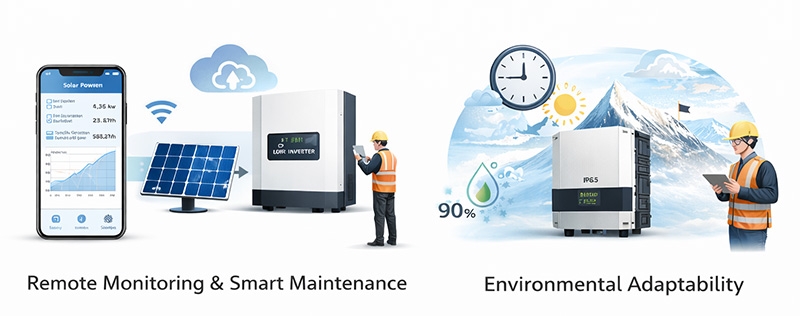
- Environmental Adaptability: Since solar panels are typically installed outdoors, inverters must be capable of operating under various environmental conditions. A minimum protection rating of IP20 or higher is recommended (our on-grid inverters have achieved IP65 protection). For harsh environments—such as high-temperature, high-humidity, or high-altitude regions—specialized inverters with enhanced cooling, moisture resistance, or corrosion protection should be selected to ensure reliable operation.
- Intelligent Monitoring and Maintenance: With the development of smart grids and energy storage technologies, solar photovoltaic systems are becoming increasingly intelligent. When selecting an inverter, features such as remote monitoring, fault diagnosis, and intelligent operation and maintenance can be considered. These functions enable real-time system monitoring, rapid troubleshooting, performance optimization, and reduced O&M costs.
Conclusion
In the design and deployment of a solar photovoltaic power system, solar panel efficiency and inverter selection are two decisive factors. By accurately calculating panel capacity, selecting properly matched inverters, ensuring voltage and efficiency compatibility, and considering environmental adaptability and intelligent operation, it is possible to achieve optimal power generation performance. This strategic matching not only improves system efficiency and reduces operational costs but also provides reliable technical support for the continued growth of renewable energy.
As technology continues to advance, solar PV systems will become more efficient, stable, and widely adopted. Continuous optimization of solar panel and inverter matching strategies will play a vital role in driving the future of sustainable energy development.
