
When you walk across open fields or along the coastline and see those tall white wind turbines slowly rotating in the distance, have you ever wondered: why do they almost always have three blades, instead of two, four, or even more? Some people think three blades simply look better. Others assume it's due to historical convention, or that fewer blades reduce cost while more blades generate more power. In reality, the answer has nothing to do with aesthetics or coincidence. It is the result of a carefully engineered balance between aerodynamics, structural mechanics, and economic efficiency.
In this article, we'll break down the science behind this design choice and, combined with the wind turbine product lineup from Inverter.com, help you move from simply “understanding” wind turbines to actually choosing the right one.
The Betz Limit — Physics Sets the Ceiling
To understand why turbines use three blades, you first need to understand a foundational law of physics: the Betz Limit. In 1919, German physicist Albert Betz mathematically proved that no wind energy device — however ingeniously designed — can convert more than 59.3% of wind's kinetic energy into mechanical power. This isn't a constraint of materials or manufacturing quality. It is determined by the physics of wind itself.
Why does this ceiling exist? Consider two extremes. If you block the wind completely with a solid plate, the airflow simply diverts around it rather than passing through to do work. On the other hand, if your blades are too sparse and widely spaced, most of the wind slips through uncaptured. The Betz Limit marks the theoretical equilibrium between these two failure modes — capturing as much energy as possible without choking the airflow that makes capture possible in the first place.
Modern three-blade horizontal axis wind turbines routinely achieve real-world efficiencies of 40–57% — remarkably close to this theoretical maximum. The three-blade configuration, refined through countless wind tunnel experiments and field deployments, is the engineering solution that consistently hits closest to that ceiling.
Lift-Based Design: Blades Are Not "Pushed" by Wind
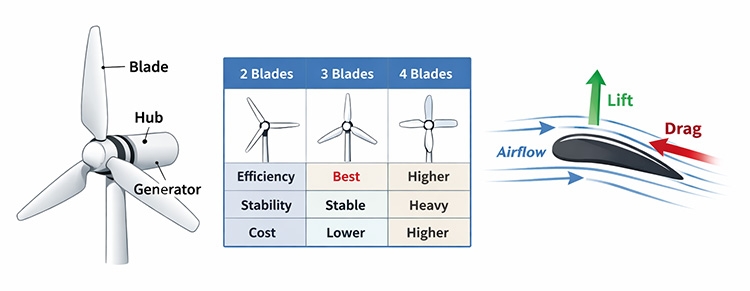
A common misconception is that wind turbine blades spin because the wind “pushes” them, like a toy pinwheel. In reality, modern wind turbines operate much more like airplane wings, relying on aerodynamic lift, not drag.
Each blade has an airfoil shape. As wind flows over it, air moves faster over the top surface → lower pressure; air moves more slowly underneath → higher pressure. This pressure difference generates lift, which drives rotation. This lift force is significantly stronger and more efficient than simple wind pressure. In essence, a wind turbine doesn’t just spin—it is "flying" in a circular motion. So why exactly three blades, spaced evenly at 120°?
- Balanced Aerodynamic Forces: Three blades ensure even force distribution around the rotor, avoiding uneven torque that could destabilize the system.
- Reduced Fatigue Load: Each blade passes through the airflow disturbance (“wake”) of the previous blade at consistent intervals. Compared to two-blade systems, this reduces resonance and long-term fatigue damage.
- Minimal Vibration: A three-blade rotor behaves closest to a perfectly balanced rotating disc. Gyroscopic forces and centrifugal loads are evenly distributed, improving durability and extending lifespan.
Put simply: three blades is the number at which everything runs smoothest.
Why Not 1, 2, or 4+ Blades?
If three blades work so well, what's wrong with the alternatives? Each case has a specific engineering answer.
- 1 Blade: In theory, a single blade can achieve high tip-speed ratios and decent efficiency. However, it suffers from extreme imbalance—like a washing machine spinning with only one wet towel inside. Counterweights are required, increasing complexity and vibration. This design is not practical for commercial use.
- 2 Blades: Two-blade turbines do exist, but they typically achieve only about 80% of the efficiency of three-blade designs. They also suffer from the teetering effect: when blades are horizontal, gyroscopic forces create periodic stress on the tower and hub. To compensate, heavier and more expensive structures are required, offsetting any cost savings. These are mainly used in niche applications like offshore floating turbines.
- 4+ Blades: Adding more blades increases drag and weight significantly, while improving efficiency by less than 2%. Worse, airflow interference between blades becomes more severe—each blade operates in the turbulent wake of the previous one, reducing performance. Traditional multi-blade windmills (such as those in the Netherlands) are designed for high torque, not electricity generation. Their purpose is to pump water, not to maximize efficiency.
Three blades, then, is not a compromise — it is the only configuration that simultaneously satisfies aerodynamic efficiency, mechanical balance, structural longevity, and cost-effectiveness.
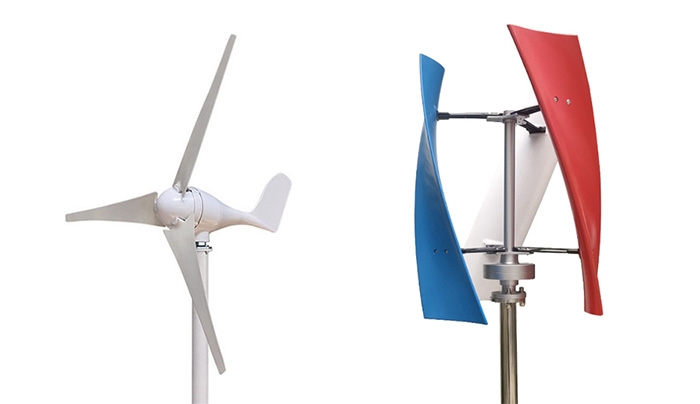
Horizontal vs. Vertical Axis: Two Interpretations of Three Blades
Inverter Online Store offers two categories of wind turbines, both built around the three-blade principle, but serving distinct use cases through different engineering logic.
- Horizontal Axis Wind Turbines (HAWT) are what most people picture when they think of a wind turbine — three blades mounted on a horizontal shaft, facing directly into the wind, with an automatic yaw system that keeps the rotor aligned as wind direction shifts. Inverter.com's HAWT lineup spans 100W to 2500W, with fiberglass-reinforced blades, start-up wind speeds as low as 2.0 m/s, rated voltages from 12V to 240V, IP54 weatherproof protection, and built-in auto-yaw. These turbines perform best in open terrain with consistent prevailing winds — coastal areas, open plains, hilltops — and are well-suited to residential, agricultural, marine, and off-grid power applications.
- Vertical Axis Wind Turbines (VAWT) rotate around a vertical shaft and require no yaw mechanism, because they capture wind equally from any horizontal direction. This makes them particularly effective on urban rooftops, in narrow corridors between buildings, and in locations where wind direction is unpredictable or frequently shifting. Inverter.com's VAWT range — also three-bladed, with curved blade geometry — is paired with a three-phase AC permanent magnet generator and intelligent microprocessor control for stable voltage output. The range covers 100W to 2000W at 12V to 96V. While peak efficiency is somewhat lower than an equivalent HAWT in ideal conditions, VAWTs compensate with near-zero maintenance requirements, lower noise output, and superior adaptability to complex wind environments.
Despite their very different visual profiles, both designs share the same underlying logic: three blades, positioned to optimize the balance between aerodynamic capture, mechanical stability, and cost per watt.
How to Choose the Right Wind Turbine?
Understanding the physics is step one. Applying it to a real purchase decision is step two. Inverter.com's product range maps cleanly to most residential, commercial, and off-grid scenarios.
- Select by power output and application:
100W – 300W: Street lighting, remote monitoring stations, small off-grid devices
500W – 800W: Residential supplemental power, boats, off-grid cabins
1,000W – 2,500W: Primary home electricity, farms, small commercial installations
- Select by installation environment:
Stable wind direction, open terrain (coastal, rural, elevated sites): HAWT — higher peak efficiency in consistent airflow
Urban rooftops, areas between structures, variable wind direction: VAWT — omnidirectional capture, low noise, low maintenance
- Match voltage to your system:
Our turbines are available in 12V, 24V, 48V, 96V, 120V, 220V, and 240V configurations, designed to integrate directly with solar charge controllers, inverters, and battery banks. This makes them a natural fit for wind-solar hybrid off-grid systems: photovoltaic panels carry the load through sunny daylight hours, while the wind turbine sustains power generation through nights, overcast days, and seasonal dips in solar irradiance — substantially improving year-round system reliability compared to either source alone.
Conclusion
Three blades are not a default. It is not a tradition. It is not a convenient midpoint. It is the answer that emerges when you work through the physics of the Betz Limit, the aerodynamics of lift-driven rotation, the mechanical demands of dynamic balance, and the economic realities of material cost — and find that all of them point to the same number.
The next time you see a wind turbine turning slowly on the horizon, you can see it differently: not as wind randomly catching on some blades, but as a precisely calculated engineering solution, spinning out exactly as much energy as the laws of physics will allow.
For anyone evaluating off-grid power or clean energy options, that understanding matters. It means you can approach a product range like Inverter.com's — horizontal axis or vertical axis, 100W or 2500W, 12V or 240V — with a clear sense of what you actually need and why. Whether horizontal or vertical axis, one thing remains constant: three blades—quietly, efficiently, and reliably capturing the power of the wind. Explore the full wind turbine range at: https://www.inverter.com/wind-turbine
