
When building a wind power system — whether for a remote homestead, an off-grid cabin, an RV, or a small commercial installation — one component sits at the center of the entire setup: the wind turbine charge controller. This device governs how electricity generated by your turbine is regulated, stored in the battery bank, and distributed to your loads. Choose the right one, and your system runs efficiently for years. Choose the wrong one, and you risk damaging your batteries, shortening the life of your turbine, or triggering costly system failures.
Yet for many first-time buyers, the sheer number of specifications — rated power, system voltage, MPPT vs. PWM, IP rating, protection functions — can feel overwhelming. This guide breaks the selection process into five clear, actionable dimensions so you can make a confident, informed purchase before you buy.
Rated Power: The Non-Negotiable First Step
Before you look at price or brand, verify one thing: the controller's rated power must be greater than or equal to your turbine's rated power. This is the most fundamental rule in wind turbine charge controller sizing, and the most commonly overlooked.
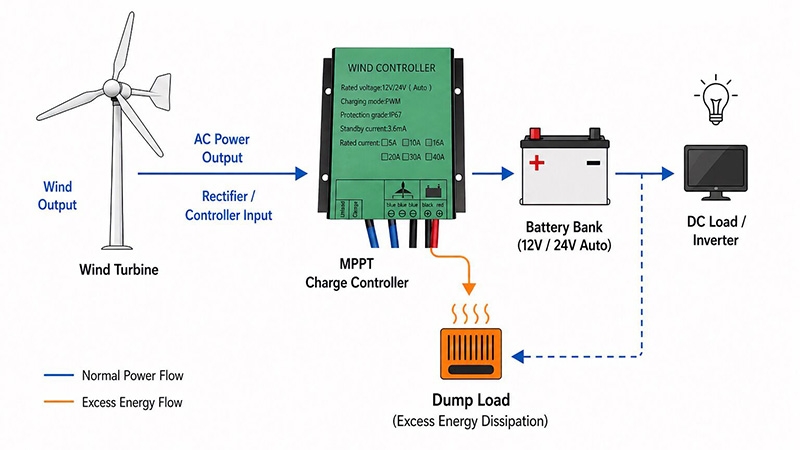
Here is the practical calculation. If your turbine has a rated power of 300W operating on a 12V system, its maximum rated output current is approximately 25A (300W ÷ 12V). Because wind speed fluctuations can produce momentary power surges above the rated value, industry best practice calls for a 20~25% safety margin on top of the turbine's rated power. This means selecting a controller rated at 300W or above, with a continuous current rating of at least 30A. Wind turbine MPPT charge controller at Inverter.com covers six power ratings across the standard range:
- Small-scale home wind turbines→ 100W~300W turbines
- Small to medium-scale off0grid systems→ 400W~500W turbines
- Larger-capacity off-grid / commercial systems→ 600W~1000W turbines
One common misconception is that "bigger is always better" — that buying a 1000W controller for a 300W turbine provides extra protection. In practice, oversizing a controller significantly reduces current detection precision, causing the charging algorithm to misread actual power output. The result is suboptimal charging profiles that gradually shorten battery lifespan. Match the power rating; do not dramatically exceed it.
System Voltage: Confirm Compatibility Before Anything Else
Once the power rating is confirmed, the next critical variable is system voltage. Standard small-to-medium wind power systems operate at 12V, 24V, or 48V. Your controller must be compatible with the actual nominal voltage of your battery bank, or the system will fail to operate correctly — and may suffer irreversible damage. Most models in the Inverter Online Shop's product lineup feature 12V/24V automatic recognition, meaning the controller detects the battery bank voltage at startup and configures itself accordingly. This eliminates the risk of manual voltage selection errors, a significant advantage for users installing their first off-grid wind system.
A practical rule of thumb for voltage selection:
- 12V systems: Best for small loads, short cable runs (under 10 meters), and entry-level setups. Lower initial cost and simpler wiring.
- 24V systems: Ideal for moderate loads and cable runs of 10–30 meters. At the same power output, current is halved compared to 12V, meaning reduced resistive line losses and thinner (less expensive) cables.
- 48V systems: Suited to large off-grid installations, commercial deployments, or systems pairing wind turbines with solar arrays. Higher voltage enables more efficient long-distance power transmission.
Note that certain 800W and 1000W controllers are available in 48V configurations in addition to 12V/24V auto. Always verify the supported voltage range on the individual product specification page, not just the product title.
MPPT vs. PWM: Technology That Directly Affects Energy Yield
This is where many buyers get stuck. MPPT (Maximum Power Point Tracking) and PWM (Pulse Width Modulation) represent two fundamentally different control technologies, with real-world differences in efficiency, adaptability, and cost.
- PWM controllers work by reducing charging current as the battery approaches full charge — narrowing the pulse width to prevent overcharging. Their circuit design is relatively simple, which keeps manufacturing costs low. For very small, low-budget systems where wind conditions are stable and consistent, PWM can be adequate. However, PWM has a critical limitation: it cannot dynamically track the turbine's maximum power output point. In variable wind conditions — which describes virtually every real-world site — this means significant energy is left on the table.
- MPPT controllers continuously monitor and adjust the controller's operating parameters to extract the maximum available power from the turbine at any given wind speed. This real-time optimization translates to 15–30% higher energy harvest compared to PWM under equivalent wind conditions. The advantage is especially pronounced during low-wind periods when turbine output would otherwise be too low for a PWM controller to effectively utilize.
All wind turbine charge controllers available at Inverter.com are full MPPT models. They also incorporate PWM-based noiseless dump load discharge — when the battery bank reaches full charge and no further energy can be stored, excess power is silently dissipated through a dump load resistor, preventing overvoltage without creating audible noise or mechanical stress on the turbine. For anyone serious about maximizing energy yield from a wind installation, MPPT is the clear and recommended choice.
IP Rating and Operating Temperature: Built for Where It Actually Gets Installed
Wind power systems are outdoor systems. Your charge controller will be exposed to dust, humidity, temperature extremes, salt air, and in some installations, occasional rain splash or condensation. This makes IP (Ingress Protection) rating and rated operating temperature range essential specifications — not optional extras.
The IP rating consists of two digits. The first indicates protection against solid particles (dust); the second indicates protection against liquids (water). For any outdoor-facing wind controller installation:
- IP65: fully dustproof + protection against low-pressure water jets. Minimum acceptable for outdoor use.
- IP67: fully dustproof + protection against temporary immersion in water. Recommended for fully exposed outdoor mounting, coastal environments, and humid tropical climates.
The 800W wind turbine MPPT charge controller and 1000W wind turbine MPPT charge controller at Inverter.com are both rated IP67, with high-quality aluminium alloy enclosures that provide both robust weather resistance and efficient passive heat dissipation. This matters for long-term deployment in pastoral farming operations, remote surveillance systems, marine applications (yachts and fishing vessels), and wind-solar complementary street lighting — all documented use cases for these controllers.
On operating temperature: a well-specified controller should function across -20°C to +60°C (-4°F to 140°F). This range covers continental climates with harsh winters (northern North America, northern Europe, Central Asian highlands) and hot desert environments (Middle East, parts of South Asia, and sub-Saharan Africa). If you are deploying in a cold-weather region, verify that the product specification explicitly states low-temperature operation capability. A controller that shuts down at 0°C during winter will leave your battery bank unprotected against deep discharge at exactly the wrong moment.
Protection Functions: The Safety Net You Cannot Afford to Skip
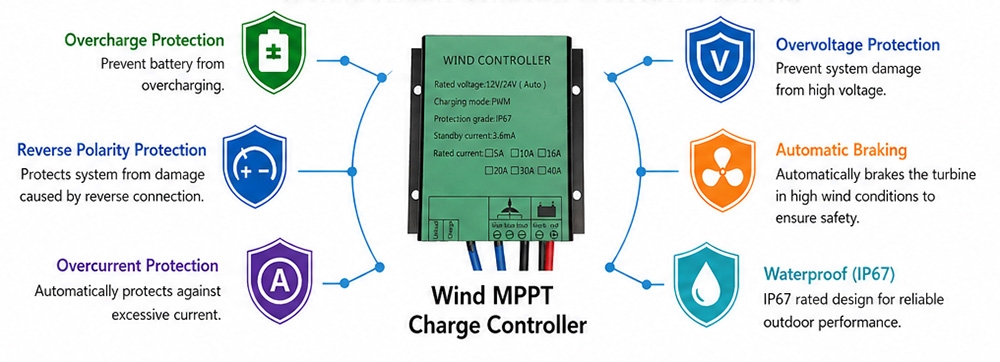
Many buyers focus on power ratings and price, but overlook the internal protection architecture — which determines how the controller behaves when something goes wrong. A properly specified off-grid wind turbine charge controller must include at a minimum the following five protection mechanisms:
- Overcharge Protection: When the battery voltage reaches the configured upper threshold, the controller automatically reduces or disconnects charging current. Without this, batteries can overheat, swell, leak electrolyte, and in worst cases, pose a fire risk. This is the most basic protection function.
- Over-discharge Protection: When the battery voltage drops to the configured lower threshold, the controller disconnects the load output, preventing the deep discharge that permanently damages lead-acid and lithium battery cells. This single function can double the effective battery service life in off-grid applications.
- Overspeed Braking Protection: This is the function that distinguishes a wind turbine charge controller from a solar charge controller. When wind speed exceeds safe turbine operating limits, and rotor speed climbs dangerously high, the controller automatically applies an electrical braking signal to the generator, preventing mechanical damage to blades, bearings, and the generator itself. Without this protection, a strong storm can destroy a turbine.
- Reverse Polarity Protection: Prevents damage from battery connection errors (reversed positive and negative terminals). Particularly important for first-time installers working with unfamiliar wiring configurations.
- Short-Circuit and Overcurrent Protection: Immediately disconnects the output circuit if an abnormal current surge is detected on the load side, protecting both the controller and the battery bank.
Beyond these core protections, look for controllers with real-time LCDs showing battery voltage, charging current, and system status. This visibility makes routine monitoring straightforward and enables early fault detection before minor issues become major failures. Some advanced models support remote monitoring via mobile or desktop interfaces — a valuable feature for wind systems deployed at unmanned remote sites.
Conclusion
If you are unsure which model best fits your specific turbine and battery configuration, visit the wind turbine charge controller full product listing at Inverter.com. All models include detailed specification sheets with full parameter tables, and the customer support team can provide selection guidance based on your turbine's rated output and site conditions. Getting the controller right is the foundation of a wind power system that delivers clean, reliable energy — season after season.
