
If you've ever stood in front of a pump lineup with a dozen horsepower options and wondered which one actually fits your system, you're not alone. Undersizing a vertical centrifugal pump leaves you with weak pressure and a system that can't keep up with demand. Oversizing wastes money upfront and burns more energy than the application needs — and can even shorten the pump's service life through excessive cycling. Getting the sizing right comes down to two numbers: flow rate and head. This guide walks through how those numbers work, what changes as horsepower increases across a vertical centrifugal pump lineup, and how to land on the right model for pipeline pressurization, HVAC, fire protection, or industrial water supply.
What Does a Vertical Centrifugal Pump Actually Do?
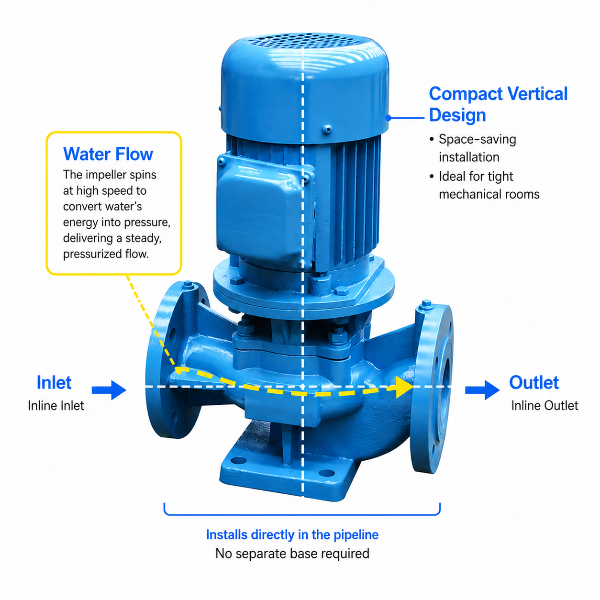
A vertical centrifugal pump moves water by spinning an impeller at high speed inside a compact, inline vertical housing. Unlike horizontal centrifugal pumps, the vertical inline design allows the pump to sit directly in the pipeline without a separate mounting base, saving floor space in mechanical rooms, pump houses, and tight industrial installations. Water enters and exits along the same axis; the impeller converts rotational energy into pressure, resulting in a steady, pressurized flow suited to continuous-duty applications such as production-line pressurization, cooling tower feed, and high-rise water supply.
The Two Numbers That Matter: Flow and Head
Every centrifugal pump is defined by its performance curve, but for sizing purposes, you really only need two figures:
- Flow rate (m³/h or GPM) — how much water the pump can move per hour. This should match or exceed your system's peak demand, not just the average.
- Head (m or ft) — how much resistance the pump can overcome, combining vertical lift, pipe friction losses, and any pressure required at the point of use.
A pump that's rated for high flow but low head will struggle in a tall building or a long pipeline run. A pump rated for high head but modest flow will pressurize efficiently but may not keep up with multiple simultaneous draws. The right pump sits at the intersection of both requirements for your specific system.
How Does the Lineup Scale?
Looking across Inverter.com's vertical centrifugal pump series is a useful way to see how flow and head actually scale with horsepower — because they don't scale in the same direction.
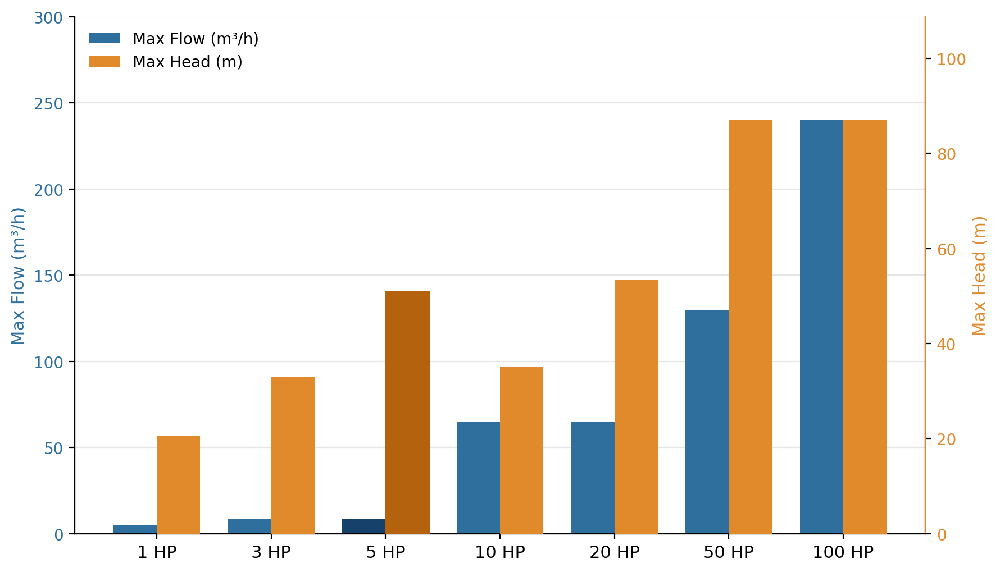
At the entry end, the 1 HP model delivers a maximum flow of 5.2 m³/h (22.9 GPM) at 20.6 m (68 ft) of head, a good fit for smaller pipeline pressurization or light-duty water supply. Step up to 3 HP and flow jumps to 8.3 m³/h with head holding around 33 m — useful when a job needs more throughput but not necessarily more lift. By the time you reach 10 HP, the pump is handling 65 m³/h at 35 m of head through a compact vertical inline structure with a 304/316 stainless steel impeller, suited to large-scale HVAC and commercial building supply.
At the top of the range, the 100 HP model moves 240 m³/h (1057 GPM) at up to 87 m (285 ft) of head — built for high-rise pressurization, long-distance water delivery, and heavy industrial loads. Between those extremes, head and flow don't increase in lockstep: some mid-range models prioritize head for vertical lift applications, while others prioritize flow for high-volume transfer. This is exactly why matching your system's actual numbers to the spec sheet matters more than simply picking "a bigger pump."
Example: The 5 HP Vertical Centrifugal Pump
A good example of where flow and head balance out for common commercial use is the 5 HP vertical centrifugal pump (ATO-VCP-4000W). It uses a single-stage stainless steel impeller, delivers a maximum flow of 8.3 m³/h (37 GPM), and reaches a maximum head of 51 m (167 ft) — noticeably higher head than the 3 HP and 4 HP models at a similar flow rate, making it a strong choice when the job calls for more lift rather than more volume. The 40mm inlet/outlet and multi-voltage 220V–480V, 50/60Hz input give it flexibility across different electrical setups, and it's commonly specified for pipeline pressurization, HVAC systems, fire protection, and general industrial water supply where consistent pressure matters more than sheer throughput.
Practical Selection Checklist
Before choosing a horsepower, walk through these steps:
- Calculate peak flow demand: Add up the simultaneous flow requirements of every outlet, fixture, or process the pump serves, not just the average draw.
- Calculate total dynamic head: Sum static lift (vertical distance), friction losses through pipe and fittings, and any required discharge pressure at the far end.
- Cross-check against the curve, not just the label: Two pumps with the same horsepower can have very different flow-to-head ratios. Match the actual numbers, not the HP rating alone.
- Confirm voltage and frequency compatibility: Most models in the lineup support multi-voltage input (220V–480V) and dual frequency (50/60Hz), which simplifies specification across regions but should still be verified against your electrical service.
- Plan for series or parallel operation if needed: Several models in the lineup, including the 2 HP, 4 HP, and 20 HP pumps, are explicitly rated for series or parallel connection, which is a practical way to reach higher flow or head without jumping to an oversized single unit.
Final Thoughts
Sizing a vertical centrifugal pump isn't about picking the biggest number available — it's about matching flow and head to the real demands of your system. Whether that's a 1 HP unit pressurizing a small pipeline or a 100 HP pump feeding a high-rise, the goal is the same: enough capacity to meet peak demand without paying for headroom you'll never use. For mid-range applications where higher head matters more than raw volume, the 5 HP Vertical Centrifugal Pump is a solid benchmark to size against.
Browse the full vertical centrifugal pump lineup at Inverter.com to compare specs side by side, or reach out to our team for help matching a model to your system's flow and head requirements.
