
When purchasing a car inverter, the question car owners ask most often is: "What appliances can this device actually power?" In fact, the answer is straightforward—the devices an inverter can power depend entirely on its output power, not on the vehicle's engine displacement or battery size. This article categorizes car inverters by power rating to systematically outline their power capabilities and important usage precautions.
Classification of Car Inverters by Power Rating
Basic Digital Devices: Under 100W (Powered directly via the cigarette lighter socket)
This power range is the safest for operation. Devices such as smartphones, tablets, laptops, camera batteries, and drone batteries generally consume between 65W and 100W of power. These devices can be powered directly through the cigarette lighter socket; using them for short periods while the engine is off poses no significant risk.
It is worth noting that the cigarette lighter fuse in most vehicle inverter models is rated at 15A, which translates to a power capacity of approximately 180W. Therefore, within this range, issues are unlikely to occur provided multiple devices are not connected simultaneously.
Practical Car Accessories: 100W to 300W (Use recommended only with the engine running)
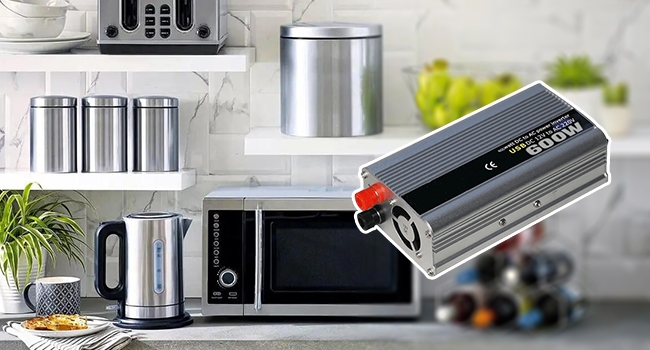
This power range of car power inverter involves a heavier load. Devices such as dash cams, portable tire inflators, car refrigerators, and electric shavers typically consume between 100W and 200W.
At this level, the cigarette lighter socket is nearing its load limit. Tire inflators, in particular, draw a high surge of current upon startup, which can easily blow the fuse. It is strongly recommended to use these devices only while the engine is running to prevent battery depletion that could leave the vehicle unable to start. If the inverter comes with battery clamps, connecting directly to the battery terminals is a safer and more reliable option.
Household-Style Appliances: 300W to 500W (Must be powered directly from the battery)
Once the power requirement reaches this level, the cigarette lighter socket is completely inadequate for the task. While the device can power appliances such as mini rice cookers (approx. 350W), small electric fans, small TVs, and projectors, you must use the included battery clamps to connect directly to the car battery.
It is important to note that the car inverter's cigarette lighter fuse is typically rated at only 15A (approx. 180W); exceeding this limit will inevitably cause the fuse to blow. Some users mistakenly assume the inverter is faulty when a rice cooker fails to operate, whereas the actual cause is a blown fuse.
Furthermore, prolonged use at this power level is not recommended. It is advisable to operate the device while the engine is running so that the alternator provides simultaneous power; otherwise, the car battery will drain rapidly.
High-Power and Prohibited Devices: Exercise Caution with Loads Exceeding 500W
Appliances such as electric kettles, vacuum cleaners, and power tools typically have power ratings between 800W and 1500W. These must be connected directly to the vehicle battery, as they place significant demands on both the inverter and the battery's capacity.
Even greater caution is required for air conditioners, microwave ovens, and high-power motor-driven equipment. The startup surge current for such devices can reach three to five times their rated power; standard inverters struggle to handle this, potentially triggering safety shutdowns or causing equipment damage. It is recommended to avoid using these types of devices inside the vehicle.
Important Considerations
- First, distinguish between pure sine wave and modified sine wave inverters. Modified sine wave (square wave) inverters are cheaper but should not be used with devices containing motors or requiring precision charging—such as electric shavers, flashlights, or medical equipment. Improper use can lead to noise and overheating, or even damage the device. For appliances like rice cookers or fans, a pure sine wave inverter is recommended.
- Second, prioritize battery protection. Avoid using electrical devices while the engine is off for more than 30 to 60 minutes, especially with high-power equipment. The best practice is to use devices while the engine is running, allowing the alternator to handle the load. Even if the inverter features low-voltage protection, do not rely on it excessively; allowing the battery to become deeply discharged will significantly shorten its lifespan.
Conclusion
In summary, the core principle for selecting and using a car power inverter can be stated simply: choose the model based on power requirements, and always connect directly to the battery for loads exceeding 200W. While car inverters offer convenient mobile power, improper use can result in anything from a blown fuse to damage to the battery and connected appliances.
